Sexual harassment

Sexual harassment in India: A crisis

Sexual harassment is frequently overlooked in India, even in the age of the MeToo movement which saw survivors share their stories and led to the downfall of numerous public figures worldwide, in politics, business, the entertainment industry, and beyond.

According to statistics recently released by the National Crime Records Bureau (NCRB), The NCRB data highlighted the plight of women in shelter homes. The maximum number of cases of sexual harassment in shelter homes was reported in Pune, followed by Mumbai. Uttar Pradesh reported more sexual harassment cases in shelter homes than any other state (239), followed by Andhra Pradesh (65) and Maharashtra (64).

Public transport is one of the many places where women can experience sexual harassment in India.

In some respects, this came as good news. “Women are more prompt these days to report any case of sexual misconduct and it is the responsibility of organisations to take speedy action,” said Suresh Tripathi, vice president of human resources management at Tata Steel. “Prompt action by organisations will act as a deterrent for others, and it will encourage women to come out and report.” As such, Tripathi adds, “increased reporting is good to start with as it means there is more awareness.”

Courageous survivors of sexual harassment and assault have had their voices heard and stories believed, thanks to the #MeToo movement. Now, there is renewed energy to make real and lasting change. Our analysis suggests that change is not only possible, but that it is already taking place in a handful of sectors and workplaces. In our accompanying toolkit, we highlight the promising research and practice-informed solutions that are working now and will propel us forward so that all people are able to have agency, respect, and opportunity at work, and to live healthy, secure, and empowered lives.

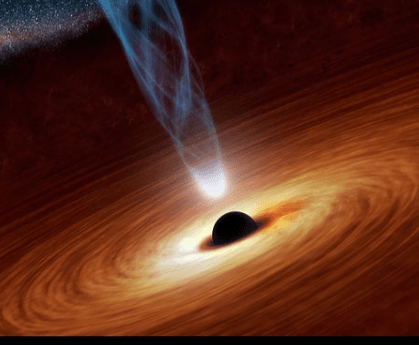
Black hole

black hole is a region of spacetime exhibiting gravitational attraction so strong that nothing—noparticles or even  electromagnetic radiation such as light—can escape from it. The theory of general relativity predicts that a sufficiently compact masscan deform spacetime to form a black hole. The boundary of the region from which no escape is possible is called the event horizon. Although the event horizon has an enormous effect on the fate and circumstances of an object crossing it, it has no locally detectable features.In many ways, a black hole acts like an ideal black body, as it reflects no light.  Moreover, quantum field theory in curved spacetime predicts that event horizons emit Hawking radiation, with the same spectrum as a black body of a temperature inversely proportional to its mass. This temperature is on the order of billionths of a kelvin for black holes of stellar mass, making it essentially impossible to observe.

Objects whose gravitational fields are too strong for light to escape were first considered in the 18th century by John Michell and Pierre-Simon Laplace. The first modern solution of general relativity that would characterize a black hole was found by Karl Schwarzschild in 1916, although its interpretation as a region of space from which nothing can escape was first published by David Finkelstein in 1958. Black holes were long considered a mathematical curiosity; it was during the 1960s that theoretical work showed they were a generic prediction of general relativity. The discovery of neutron stars by Jocelyn Bell Burnell in 1967 sparked interest in gravitationally collapsed compact objects as a possible astrophysical reality.

Black holes of stellar mass are expected to form when very massive stars collapse at the end of their life cycle. After a black hole has formed, it can continue to grow by absorbing mass from its surroundings. By absorbing other stars and merging with other black holes, supermassive black holes of millions of solar masses  may form. There is consensus that supermassive black holes exist in the centers of most galaxies.

The presence of a black hole can be inferred through its interaction with other matter and with electromagnetic radiation such as visible light. Matter that falls onto a black hole can form an external accretion disk heated by friction, forming some of the brightest objects in the universe. Stars passing too close to a supermassive black hole can be shred into streamers that shine very brightly before being “swallowed.” If there are other stars orbiting a black hole, their orbits can be used to determine the black hole’s mass and location. Such observations can be used to exclude possible alternatives such as neutron stars. In this way, astronomers have identified numerous stellar black hole candidates in binary systems, and established that the radio source known as Sagittarius A*, at the core of the Milky Way galaxy, contains a supermassive black hole of about 4.3 million solar masses.

On 11 February 2016, the LIGO collaboration announced the first direct detection of gravitational waves, which also represented the first observation of a black hole merger. As of December 2018, eleven gravitational wave events have been observed that originated from ten merging black holes (along with one binary neutron star merger). On 10 April 2019, the first ever direct image of a black hole and its vicinity was published, following observations made by the Event Horizon Telescope in 2017 of the supermassive black hole in Messier 87‘s galactic centre.

Schwarzschild black hole

Simulation of gravitational lensing by a black hole, which distorts the image of a galaxy in the background

Gas cloud being ripped apart by black hole at the centre of the Milky Way (observations from 2006, 2010 and 2013 are shown in blue, green and red, respectively).